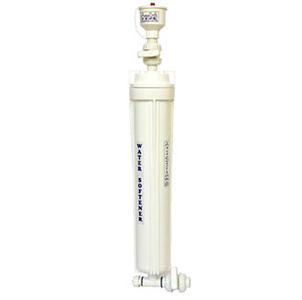
Aquasoft Water Softener
- Improves the taste of water
- Leaves cars sparkling
- Helps in developing a glowing skin, Shiny Hair and helps to prevent excess hairfall
- Product Details
- Product Specifications
- Product Reviews
AquaSoft Water Softener eliminates the salts responsible for hardness from the water, namely Calcium and Magnesium. In the softener there are millions of tiny polymer beads (resin) which carry a Sodium ion charge. As the water flows over this resin, the Sodium ion thereby softening the water. Sodium is extremely soluble in water and does not precipitate on heating, thus eliminating all the problems associated with hard water. When all the Sodium ions have been extracted by the hard water, the resin is regenerated by washing it in a concentrated salt solution (brine). This allows the AquaSoft Water Softener to be used again and again. (The process of washing the resin in a concentrated solution of brine is called regeneration).
How frequently does the AquaSoft softener need to be regenerated?
This depends upon the degree of hardness of the water and the amount of water drawn from the softener. A simple qualitative way of determining the need for regeneration would be by trying to obtain lather with soap using the water drawn from the softener. If the lather forms easily, then the water is soft, if not, the resin should be regenerated.
Alternative one may use the AquaSoft Hardness Test Kit to determine the hardness. If the hardness if above 50 p.p.m then the resin should be regenerated.
Applications
- Drinking Water : For drinking water it is desirable that the total hardness does not exceed 300 parts per million (p.p.m) as per I.S.I standards. Corporation water hardness of between 50 to 200 p.p.m which accounts for its sweet taste of water gets adversely affected.
- Hair & Skin : Hard water does not easily produce a lather with soap. Infact it leaves an insoluble sticky residue which though not highly visible, clings to the hair and skin leaving the hair feeling sticky & lifeless, and the skin feeling dry.
- Gadgets : Hardness also leaves white salt deposits whenever water is heated, this is called scaling.
- Geysers : These salt deposits coat the elements of geysers, leading to increased electricity consumption and reducing in the life of the element.
- Steam Irons : The salts deposits block the vents of steam irons.
- Solar Water Heaters :The salt deposits also choke the water pipes in Solar Water Heaters.
- Washing Machines : Since hard water dose not easily produce a lather, the efficiency of washing machines adversely affected. Clothes lose their brightness and shine. Moreover the salt deposits will damage the heating elements in fully automatic washing machine.
- Floors & Kitchen Utensils : When the hardness is very high it also leaves white marks on the floors after they have been mopped, and salt encrustation on kitchen utensils used for cooking.
- Sanitary Fixtures : Hard water stains and damages sanitary fixtures.

Speak to our experts
Mr Satish : Silk Board, HSR L/o, Sarjapura Road, Bellandur outer Ring road, Electronic City, Hosur, Koramangala, Begur, Bommasandra Indl Area, Huskur Road, Hosur Road, Anekal. Mobile :- +91 9538885314
Mr Manjunath : Banashankari, Giri Nagar, Jayanagar, Padmanabha Nagar, Giri Nagar, Ittamadu, Uttarhalli, JP Nagar, BTM, Kanakapura Road, Chamarajpet, Majastic, Malleswaram, Basavangudi, Gottigere, Bannerghatta Road, Basaveshwar Nagar. Mobile:-+91 9538885315
Mr Anto : Mahadevapura, Kundalahalli, Hoodi, Hope Farm, Whitefield, Brookefield, ITPL, Channasandra, Seegehalli, Gunjur, Marathalli, Munnekolalu, Varthur, Yemlur, KRPuram, Kadugodi, Bhudhigere, Kannamangala Hoskote, Virgo nagar,Benniganhalli, Viginapura. Mobile:- +91 9538885320
For Service : +91 9379197383 OR 
Mr Murali : Peenya, Yeshwanthpur, Tumkur Road, Dasarahalli, Laggere, Nelamangala, Sunkada katte, Kamakshi palya, 8th Mile, Bagalagunte, Hesaragatta, BEL, Vidyaranyapura, Yelahanka, Devanahalli, Sahakar Nagar, New Airport Road, Nandhi Hills, Jalahalli, Sanjay Nagar. Mobile :- +91 9538885329
Mr Santhosh : Rajaji Nagar, Mysore Road, R R Nagar, Kengeri, Nagarbhavi, Vijaynagar, Magadi Road, ,Bangalore Central, Wilson Garden, Richmond Town, Benson Town, RT Nagar, Bagalur, Hebbal, Sahakar Nagar, Veeranapalya, Nagwara, Hegde Nagar, Vasanth Nagar, Race Course Road. Mobile :- +91 9538885321
Mr Iyappa : Ulsoor, Domlur, Indiranagar, Basavanagar, Vignan Nagar, HAL, Old Airport Road, Murugesh playa, Nagawar Palya, Kagdaspura, CV Raman Nagar, New Thippasandra, Kasturi Nagar, Kammanahalli, Maruthi Seva Nagar, Frazer Town, C.K.Garden, Ramamurthy Nagar, TC palya, HRBR Layout, Kalayanagar, Horamavu, NGEF Layout. Mobile :- +91 9538885317
Office Number : +91 9845043424
Quick Contact Form!!
(Only for Bengaluru residents)
